
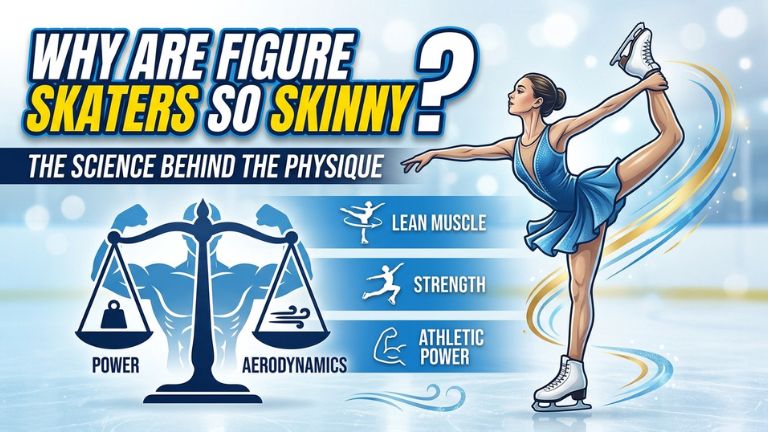
Figure skaters look lean mainly because of the physics of jumping and spinning. Carrying strong muscle with low excess weight improves their power-to-weight ratio, which helps them launch 5 to 8 times their body weight into the air and spin faster by reducing rotational inertia. Heavy training volume (20 to 30 hours weekly) and the aesthetic side of judging also shape body composition.
On the ice, skaters look slender and light. But that look is the result of extreme athletic specialization, not simply low body weight. Underneath is dense, strong muscle built for explosive power.
In this guide, I will explain the physics behind the lean look, how skaters train, how disciplines differ, and why the sport is moving toward health and strength.
The Physics of Figure Skating: Power-to-Weight Ratio
Physics explains most of what you see. Jumping and spinning reward skaters who can produce a lot of power from a compact body. Here are the three main forces at work.
Explosive Vertical Jump Mechanics
Every extra pound of mass that does not help with power makes a jump harder to launch. Triples and quads need a huge burst of energy to get high enough to rotate. That is why strength and efficiency matter more than size.
Moment of Inertia and Spin Speed
A narrow body with the arms and legs pulled in tightly reduces rotational inertia. That lets a skater spin much faster, with rotations exceeding 400 RPM in the air. It is the same effect you see when a spinner pulls their arms in.
Landing Impact Absorption
A skater absorbs 5 to 8 times body weight on a single 4mm steel blade. Doing that safely takes real strength.
Lean Muscle vs. Bulk: How Figure Skaters Train
Slender does not mean weak. Skaters are often much stronger than they look. Their training builds a specific kind of muscle.
Fast-Twitch Muscle Dominance
Skaters focus on explosive power, not on building bulky muscle. Fast-twitch fibers help them jump and accelerate quickly. The goal is strength and speed, not size.
High Weekly Training Volume
Skaters train 20 to 30+ hours a week, combining on-ice practice, off-ice plyometrics, ballet, and core conditioning. That training burns thousands of calories each day.
It also means skaters need plenty of food to recover.
Core and Lower-Body Specialization
Skaters develop highly trained glutes, quads, and deep stabilizer muscles, with little upper-body bulk. This is why they can look lean and still land big jumps.
Body Composition Across Skating Disciplines
Different disciplines ask for different strengths. This table shows how the demands vary. It describes what each role needs for performance, not what any skater should look like.
| Skating Discipline | Body Composition Focus | Primary Biomechanical Advantage | Caloric and Energy Demands |
|---|---|---|---|
| Freestyle (men and women) | Low body fat, high explosive power | Maximizes rotational speed and jump height | Extremely high (HIIT jump intervals) |
| Pairs (female partner) | Light, strong frame | Ease of overhead lifts and throw jumps | Controlled energy availability |
| Pairs (male partner) | Dense upper-body and leg muscle | Lifting power and throw stability | High caloric intake (3,000+ kcal) |
| Ice dance | Lean, athletic, aesthetic focus | Deep edge stamina, twizzle speed, and flow | Moderate to high (endurance and core) |
Height, Leverage, and the Visual Illusion on Ice
Part of the lean look is simple perception. Skaters often look smaller and thinner than they are. Two things play a role.
The Height Advantage
Many skaters are on the shorter side, averaging 5’0″ to 5’4″ for women and 5’6″ to 5’8″ for men. Shorter lever arms make rotational control easier. That is one reason the sport tends to favor compact builds.
Costume and Lighting Optics
Form-fitting, high-waisted costumes and bright rink lighting accentuate a slender silhouette. Judges and audiences see a stylized image on the ice. Off the ice, skaters often look different.
The Shift Toward Health, Strength, and Sports Science
It would be dishonest to talk about skater physiques without mentioning the pressure that has existed in the sport. Figure skating is a judged sport, and aesthetics have played a role in scoring. The good news is that attitudes are changing.
Addressing Historical Issues
There has been open discussion about past aesthetic pressures, RED-S (Relative Energy Deficiency in Sport), and disordered eating in judged sports. These are real health risks. Under-fueling can lead to fatigue, stress fractures, and long-term harm.
Modern Nutritional Science
Elite federations now put more weight on functional strength, sports nutritionists, and injury prevention than on strict weight targets. The focus is on fueling the athlete, not shrinking them. That approach supports better performance and longer careers.
Age-Limit Changes
Raising the senior eligibility age to 17+ encourages more mature, sustainable, and adult athletic body structures. Skaters have more time to develop strength before they face the highest demands. That helps protect both their health and their careers.
If you or someone you know struggles with food or body image, please talk to a doctor or another qualified professional. A healthy skater is a strong skater.
Final Thoughts
Skaters’ lean physiques are a natural adaptation to rotational physics, heavy training volume, and the need for explosive power. The look comes from strength and specialization, and not from simply weighing less. The sport is steadily moving toward fueling, health, and sustainable training.
Frequently Asked Questions
Are figure skaters stronger than they look?
Yes, in most cases. Landing jumps takes a lot of strength, since the body absorbs 5 to 8 times body weight on a thin blade. Their training builds powerful legs and a strong core, even when the muscle does not look bulky.
Why are male figure skaters so lean compared to hockey players?
The two sports ask for different things. Figure skaters need to rotate and jump high, so low excess mass and fast-twitch power help. Hockey players need to take contact and generate force, so heavier, more muscular builds are common.
Do figure skaters follow strict diets?
Skaters need a lot of fuel to support heavy training, so healthy plans focus on eating enough. Many work with sports nutritionists.
How does height affect figure skating performance?
Shorter skaters have shorter lever arms, which makes rotation and control easier. Taller skaters can succeed too, but they may need to work harder on speed and spin control. Height is one factor among many, including technique and training.
