
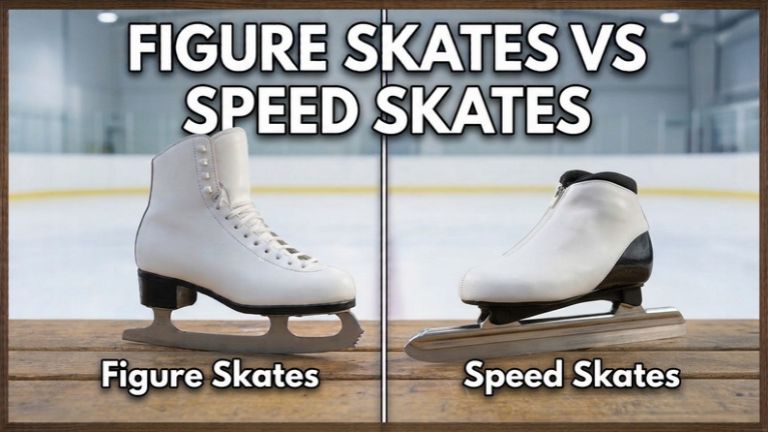
Figure skates and speed skates sit at opposite ends of the ice sports world. One is built for jumps, spins, and artistic control, and the other is built for pure speed. Put them side by side and you can see the difference right away.
The main difference is blade length, blade thickness, and boot height. Figure skates have shorter, thicker blades with toe picks, attached to high-cut boots that support the ankle during jumps. Speed skates have very long, paper-thin blades (often with a hinged “clap” mechanism) and low-cut, flexible boots that maximize stride length and top speed.
In this guide, I will break down how the blades and boots differ, how the technique changes, and whether you can swap one for the other.
Figure Skates vs Speed Skates at a Glance
This table shows the key differences in one place. Each row connects to something you will feel on the ice.
| Feature | Figure Skates | Speed Skates |
|---|---|---|
| Blade length | Slightly longer than the boot sole (about 11 to 12 inches) | Very long (about 16 to 18 inches), extending far past the toe and heel |
| Blade thickness | Thicker (about 3.8 to 4 mm) for deep edges | Ultra-thin (about 1 to 1.1 mm) for minimal friction |
| Toe pick | Yes, front teeth for jumps and spins | No, flat and straight runner |
| Boot height | High-top leather or synthetic with rigid ankle support | Low-cut, slipper-like carbon fiber with maximum ankle flex |
| Blade mechanism | Fixed, rigid mounting | Fixed (short track) or hinged clap (long track) |
| Primary goal | Jumps, spins, and edge precision | Straight-line speed, low drag, and long strides |
Exact sizes vary by brand, skater size, and discipline. Treat these numbers as typical ranges.
Blade Anatomy: Precision and Edges vs. Length and Drag Reduction
The blades are where these two skates differ the most. Each one is shaped for a very different job. Let me start with figure skates.
Figure Skate Blades
Figure skate blades have a toe pick at the front. Skaters use it to launch jumps like the flip and lutz and to anchor certain spins. Speed skaters never use a toe pick, because it would catch the ice at high speed.
The blade also has a curved profile, called a rocker, and a hollow groove along the bottom that creates two distinct edges. This setup allows tight turns and deep edge cuts. It is also why figure skaters can carve such controlled curves.
Speed Skate Blades
Speed skate blades are much longer and much thinner. They have a very gentle curve, so a large amount of steel stays in contact with the ice. This helps transfer force into forward motion and keeps friction low.
Long track speed skaters often use clap skates. The heel of the blade is on a spring-loaded hinge, so the blade stays on the ice longer as the ankle extends. That adds extra push to every stride.
Boot Structure: Ankle Lock vs. Ankle Freedom
The boots are designed around opposite needs. Figure skaters need support, and speed skaters need freedom. This changes how each boot is built.
Figure skate boots are stiff and high cut. They absorb the large impact forces that come from landing jumps and help prevent the ankle from rolling. That support is what lets skaters land with control.
Speed skate boots are custom molded and very light, often made from carbon fiber. They are cut low below the ankle, which allows deep ankle bend and knee flexion. This lets skaters hold the low crouch that speed skating needs.
Neither boot is better overall. Each one fits the demands of its sport.
Skating Mechanics: How Technique Differs
The skates shape the way you move. Even simple actions, like pushing off, look different in each sport.
Push-Off Mechanics
Figure skaters push off the inside edge of the blade and use the toe pick at times. Speed skaters push sideways off long, flat glides. Their strides are wide and powerful, with long stretches of gliding between pushes.
Turning and Crossovers
Figure skaters lean onto deep edges to carve curves, and they work with precise footwork. Speed skaters lean hard into the turns, using the long blade and, in short track, a blade mounted off center. This helps them hold a tight line at high speed.
Speed vs. Control
Speed skates can reach speeds above 30 mph (about 50 km/h) in competition. The long, thin blade keeps friction low and lets the skater stretch each stride. Figure skates give up some of that speed in return for rotational control and agile footwork.
Can You Use Speed Skates for Figure Skating or Casual Skating?
In short, no, not for figure skating. Speed skates are not built for jumps or spins. The long, thin blade and low boot give almost no ankle support, which makes those moves unsafe.
The reverse is also true. Figure skates cannot match the speed of speed skates, because the thicker blade creates more friction and the shorter blade gives a shorter stride. You can race in them for fun, but you will not get the same result.
What about casual public sessions? Figure skates are usually the better pick. They offer far better maneuverability in a crowded rink, and the boot supports your ankle. Speed skates feel fast but can be hard to control around other skaters.
Final Thoughts
Figure skates and speed skates are built for different goals. Figure skates focus on artistic precision, edge control, and vertical power for jumps. Speed skates are built to be specialized tools for horizontal speed.
Think about what you want to do on the ice, and choose the skate that fits that goal.
Frequently Asked Questions
Why are speed skate blades so much longer than figure skate blades?
The extra length gives speed skaters a longer stride and more contact with the ice for each push. It helps them build and hold speed over a long distance. Figure skaters need a shorter blade so they can turn, jump, and spin with control.
Are figure skates or speed skates harder to learn?
They are hard in different ways. Figure skating asks for balance, edge control, and many technical skills such as jumps and spins. Speed skating asks for strong technique in the crouch, the push, and fast turns. Both take time, and the answer depends on the skater.
What is a clap skate in speed skating?
A clap skate is a speed skate with a hinge at the heel of the blade. The heel lifts off the boot as the skater pushes, which keeps the blade on the ice longer. That adds power to each stride, and the blade snaps back with a clapping sound.
Are speed skate blades sharpened the same way as figure skate blades?
No. The two blades have different shapes and profiles, so they need different sharpening methods and equipment. Figure skates use a specific hollow and need a technician who knows figure skate profiles. Speed skates should go to someone who works with speed skate blades.
